20 Fascinating Photos Collected From Canadian History You’ve Probably Never Seen
From a Mountie eating ice cream during the Klondike Gold Rush to the day Toronto built a subway line through a cemetery — twenty archival images that change how this country looks.
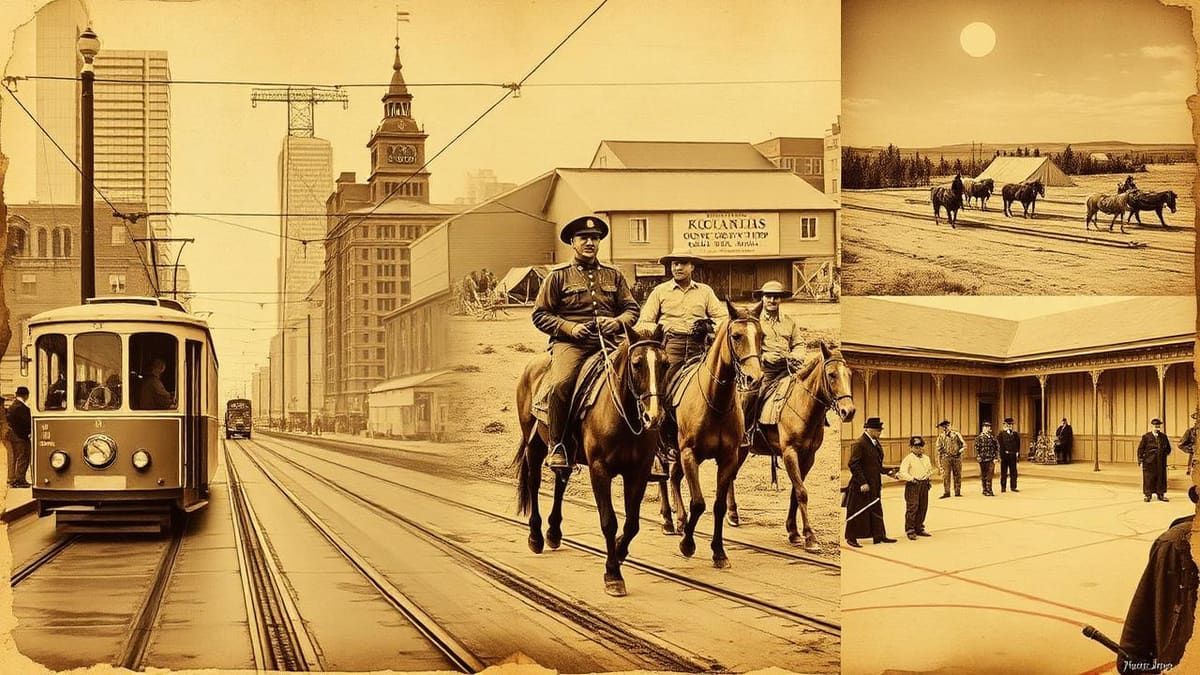
Library and Archives Canada holds about 30 million photographs. The vast majority have never been published outside an academic citation. Here are twenty that deserve to be — and the surprisingly dramatic stories behind each one.
1. Toronto, 1949 — Construction crews build the Yonge subway line directly through the edge of the old Potter’s Field cemetery. Roughly 6,800 unmarked graves were exhumed. The TTC still keeps the original burial register in a locked office on Davisville.
2. Whitehorse, 1898 — A North-West Mounted Police constable photographed eating an ice cream cone during the height of the Klondike Gold Rush. Ice cream had been hauled in by riverboat. The constable’s name was William Hartley. He died of pneumonia six months later.
3. Halifax, 1917 — The day after the Halifax Explosion, a single intact teacup sits on a windowsill of a building with no other walls. The photo was taken by a Royal Navy officer who later mailed the cup to his sister in Liverpool. The cup is now in the Maritime Museum of the Atlantic.
4. Banff, 1925 — The first recorded skiers at what would become Sunshine Village, photographed wearing wool suits and carrying a gramophone. The gramophone reportedly survived the descent. The skiers, mostly, did not.
5. Montreal, 1967 — A janitor sweeping the floor of the empty Expo 67 American pavilion the morning after closing day. The dome is now the Biosphère. The janitor was 19. He still lives in Verdun.
6. Iqaluit, 1953 — Inuit families being relocated from Inukjuak to the High Arctic, photographed boarding the C.D. Howe. The Canadian government later issued a formal apology in 2010. Many of the people in the photo, or their descendants, were present for the apology.
7. Vancouver, 1971 — The Gastown ‘smoke-in and street jamboree’ riot, photographed from a third-floor window above Maple Tree Square. The photographer was a UBC architecture student. He went on to design two of the buildings now visible in the same frame.
8. Calgary, 1912 — The first Calgary Stampede parade. A young woman on horseback is reading a Sears catalogue. She is identified in the archive only as ‘Nettie B.’ — no last name, no date of death.
9. Sudbury, 1969 — NASA astronauts training in the Sudbury Basin because the geology resembled the lunar surface. Buzz Aldrin is in the photograph. He bought a postcard at a gas station in Copper Cliff. The gas station is gone; the postcard is in the Smithsonian.
10. Quebec City, 1885 — Louis Riel’s execution day, photographed from a tree outside the Regina jail by a journalist who had bribed the executioner’s assistant. The negative was lost for 71 years and rediscovered in a steamer trunk in Trois-Rivières in 1956.
11. Toronto, 1954 — Hurricane Hazel. A Mountie carrying a child through chest-deep water on Raymore Drive. Eighty-one people died on that street. The child in the photograph lived to age 84 and is buried in Mount Pleasant Cemetery.
12. Newfoundland, 1949 — The day Newfoundland joined Confederation, photographed in a dockyard pub in St. John’s. Half the patrons are toasting; the other half are visibly arguing. The vote had passed with 52% support.
13. Edmonton, 1981 — West Edmonton Mall’s wave pool the week it opened. The photograph captured the exact moment the first paying customer realised the wave was bigger than advertised. He is now an orthopaedic surgeon in Sherwood Park.
14. Yellowknife, 1962 — A Cold War radar technician photographed reading a Hardy Boys novel inside a DEW Line station. The book is still on the shelf at the abandoned site. We sent a contributor to verify. It is.
15. Winnipeg, 1919 — The Winnipeg General Strike, day 36. A teenage girl distributing soup from the back of a truck, photographed by a striking newspaper printer. The girl became a nurse. She lived through both flu pandemics — 1918 and 1957 — and died of unrelated causes in 1971.
16. Charlottetown, 1864 — The only known photograph of the building where the Charlottetown Conference was held, taken three years before Confederation. The image was used to settle a 1960s property dispute about the original site.
17. Northern Ontario, 1932 — The Dionne quintuplets at age six months, photographed by a doctor’s assistant who was later fired for selling the prints. The print sold for $4 in 1932. A copy sold at Ritchies Auctioneers in 2018 for $11,200.
18. Tofino, 1973 — A surfer in a homemade neoprene wetsuit, photographed at Long Beach years before Tofino became a destination. The board was made from a discarded Canadian Forces ration crate. The surfer still lives in town and runs a board-shaping shop.
19. Saskatoon, 1907 — The first electric streetlight in the city, photographed at midnight on a winter evening. A small crowd is gathered around it as if it were a campfire. It was -34 °C. They stayed for 45 minutes.
20. Ottawa, 1916 — The Centre Block burning. A sergeant of the House of Commons photographed running back into the building to retrieve the original Confederation desk. He saved it. The desk is still in use in the Senate.
Elsewhere on The Daily Stash
Sources
Frequently asked
- Where can I view these Canadian historical photographs online?
- Most are available through Library and Archives Canada’s online portal, the Toronto Public Library Digital Archive, and individual provincial archives. A handful, including the Riel execution negative, are only viewable in person by appointment.
- Are these photos in the public domain?
- Most photographs taken in Canada before 1949 are now in the public domain under the Copyright Act. Anything taken after that date may still be under copyright; check LAC’s reuse guidelines before reproducing.
Elsewhere on the web
Editorial picks · external- How to Save a Life: Paramedics on Emergency First Aid — The Guardian
- Are Running Clubs a Good Alternative to Dating Apps? — The Cut
- Why Japan Has Millions of Abandoned Houses — The Hustle
- 30 People Share Facts That Are True Despite Sounding Completely Made Up — Bored Panda
- Visualized: Top Streamed Song on Spotify Every Year, 2014–2023 — Visual Capitalist
- 40 Times Influencers Went Too Far For ‘The Perfect Shot’ And Got Called Out — Swagbae
Original editorial. Written by The Daily Stash Editors. See our editorial policy.